

Here is a simple workaround to save images and videos embedded in Microsoft Office files. It is easy to insert images, videos, and audio files in Microsoft Word, Excel, and PowerPoint, but when it comes to saving these embedded files, it can be a time-consuming process. However, there is a secret method to copy all media files at once from Office files.
The latest versions of Microsoft Office (Office 2007 and onwards) save files in Office Open XML formats, specifically .docx for Word, .xlsx for Excel, and .pptx for PowerPoint. It is worth noting that Office Open XML formats are essentially zip files. Therefore, you can extract these Office files to gain direct access to all embedded files and data, including images, videos, audio, or other content.
How to Copy Media Files Embedded in Microsoft Office File?
Generally, when people come across media files embedded in an Microsoft Office file, they tend to right-click each file to save it individually on their computer. However, this process can be tedious and time-consuming, particularly if there are numerous embedded files to handle.
A more efficient approach is to extract the entire Office file, as unzipping it is often quicker than manually searching for and copying or extracting each individual image or media file within the Office file.
How to Use 7-Zip or Unarciver to Copy Media Files Embedded in Microsoft Office File?
1. First, install 7-Zip app on your Windows computer (If your Windows 11 supports 7-Zip, then skip this part). Mac users can use Unarchiver app.
2. Now, right-click the Office file from which you want to copy media files.
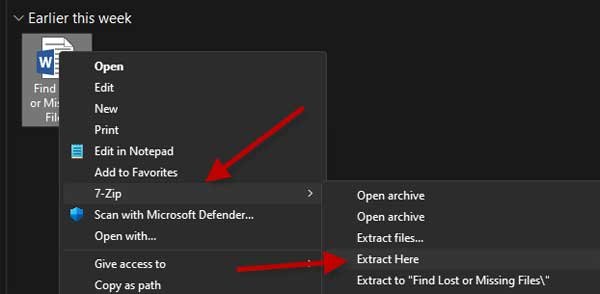
3. Select 7-Zip from the context menu and choose “Extract Here” option. It will unzip the Office file in the same directory.
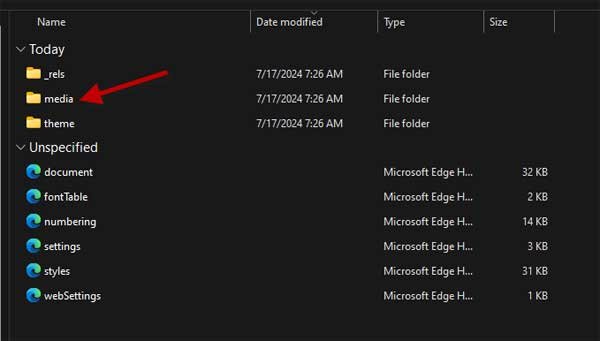
4. The extracted file contains a few XML files and folders. The main folder, such as “word” for Word files or “ppt” for PowerPoint files, includes a “media” directory with all the embedded files.

5. Now, open the “word” or “ppt” folder, and then open the “media” folder. Here, you will find all the files embedded in the Office files. You can copy the required files from this directory.
Note that media files do not retain their original names when unzipped, so you will not be able to search for them by their original file names. However, the original file extensions and some other metadata are still present.

